Category: Public Events
Health Humanities in Medical Education
On Thursday 11 and Friday 12 December, two colleagues from the University of Toronto will be visiting our faculty for a number of activities focusing on the opportunities that health humanities offer for medical education.
The speakers – Dr. Sarah Kim and Dr. Hartley Jafine – are both involved in medical education at their university.
Programme
Thursday 11 December
10 a.m. to 1 p.m.: presentation of Health Humanities, “good practices” from Toronto and Ghent
(Dr. Sarah Kim, in collaboration with the International Thematic Network CHARM, Prof. Ruth Piers, Prof. Dominique Benoit)
3-6 p.m.: “good practices” from Toronto and Ghent
(Dr. Sarah Kim, Dr. Hartley Jafine, Prof. Jürgen Pieters, Prof. Dr. Mirko Petrovic, Dr. Fleur Helewaut and others)
Friday 12 December
10 a.m.-12.30 p.m. workshop “improvisational theatre in medical educational contexts” (Dr Hartley Jafine) – this workshop is intended for (and limited to) Skills Lab staff
2.30-4.30 p.m. Round table and group discussion: what can we take away for the future?
Anyone who would like to participate in (one of) these activities can register via this link.
Accreditation is being requested.
If you have any questions, would like to contribute something yourself, or would like to see a particular topic addressed, please contact Fleur Helewaut
Workshop: Narrative Medicine as Stance and Practice
2024, May 30-31: Workshop Narrative Medicine as Stance and Practice
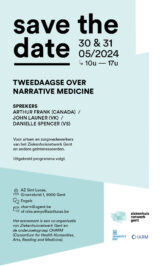
Two-day workshop organised in collaboration between CHARM (Consortium for Health Humanities, Arts, Reading and Medicine) and the Ghent Network of Hospitals.
The aim of this two-day workshop is to introduce the audience – doctors, nursing and administrative staff of the Ghent Hospitals, but also other interested parties – to the practice and the concepts underlying that practice of what is called narrative medicine. Narrative medicine has multiple aspects: it is an ethical stance, an innovative form of medical education, and a way to engage in clinical practice. Our three speakers – international authorities in the field – will show in their workshop-based interventions how this narrative practice can be of interest to different actors in the hospital environment: not only patients, doctors and caregivers, but also relatives and loved ones of patients and administrators of hospitals. Our three speakers have collaborated previously, but they approach narrative medicine from different perspectives, including different countries. Their presentations will provide ample opportunity for dialogue among participants.
Venue: AZ Sint-Lucas. Groenebriel 1, 9000 Ghent
Conversation Series: Reading in Times of Vulnerability
2023, February-May: Lezen in tijden van kwetsbaarheid (Reading in Times of Vulnerability)
In the spring of 2023, in collaboration with the Humanities Academy we engaged in a conversation with artists, carers and audience members about what it means to be vulnerable today – negatively and positively. About the limits of vulnerability and the power of vulnerability. About the unifying role that art and culture can play. About the support the community can offer the individual. Find all practical information and the list of partners on the Humanities Academy’ s website (in Dutch).
Aflevering 1: Zingen over zorgen
Aflevering 2: Kwetsbaar (Samen) Lezen
Aflevering 3: Jong geweld: met woorden aan de toekomst bouwen
Aflevering 4: Stof en stilte: ouderen, eenzaamheid en lezen
Conversation Series: Reading in Times of Caring (in Dutch)
2022, February-May: Lezen in tijden van zorgzaamheid (Reading in Times of Caring)
Since ancient times, stories have been associated with care and healing, and literature has been seen as a powerful social tool of connection. Even in times of social distance, stories (literary and otherwise) bear witness to this power. In this series of six discussion evenings, experts from the worlds of care and literature have explored ways in which the two disciplines can find and strengthen each other. What is the place of reading and reading aloud in nursing education? What are the implications of a deep engagement with care for the study of literature and other human sciences? Can such an exchange also deepen our experience of literature and art? Or can telling stories and reading a novel or a poem actually be harmful? What role can literature play in inclusive and multicultural care contexts?
These and many other questions guided the overarching narrative that Zoë Ghyselinck and Jürgen Pieters wanted to bring to the series ‘Reading in times of caring’. Together with their guests, Ghyselinck and Pieters spoke about issues that affect us all: feelings and practices of mourning, coping with old age, the comfort of reading, contact with people from other cultures, the identity of the outsider. In collaboration with the Humanities Academy of Ghent University. Find all practical information and the list of partners on the Humanities Academy’s website (in Dutch).